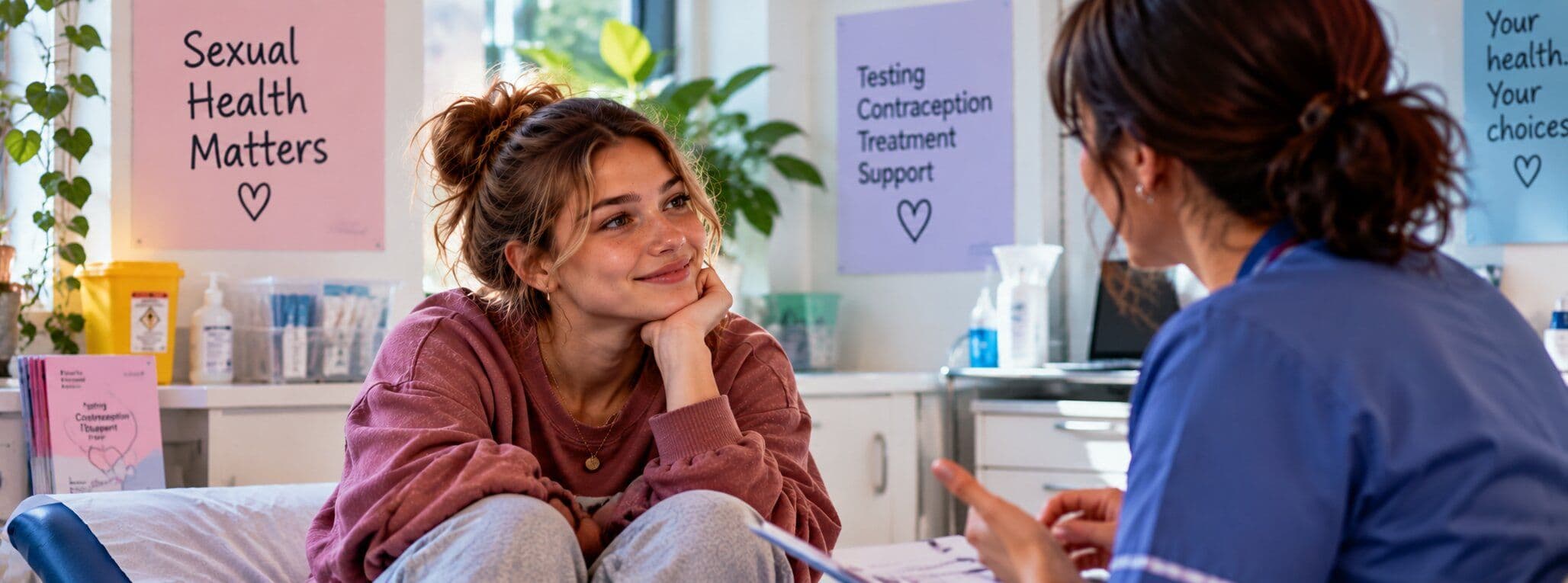

If you’ve never had an STI test before, the idea of going to a clinic, answering questions about your sex life and giving samples can feel a bit intimidating.
You might be wondering:
What will they ask me?
Do I have to get examined?
Will someone see me naked?
Does it hurt?
Can I get tested without going to a clinic?
What happens if the result is positive?
Will my GP find out?
The short answer is: STI testing is usually much simpler and less awkward than people imagine.
And you don’t need to have symptoms to get tested. Many STIs don’t cause obvious symptoms, so testing can be the only way to know what’s going on. (SH24)
First things first: you don’t need to be embarrassed
Sexual health clinics deal with this every day.
They aren’t there to judge who you’ve slept with, how many people you’ve slept with, whether you used a condom, whether you’ve been drinking, or anything else about your sex life.
Their job is simply to help you look after your sexual health.
You can also ask questions. If you don’t understand why you’re being offered a particular test, ask. NHS guidance says the clinician should explain what’s happening and why they’re recommending particular tests. (nhs.uk)
Where can you get an STI test?
Depending on where you live, you may be able to get tested through:
an NHS sexual health clinic
a genitourinary medicine (GUM) clinic
a sexual and reproductive health service
some GP surgeries
some pharmacies
some young people’s services
an online or postal testing service
NHS sexual health testing and treatment services are available free of charge, although the exact services available vary between areas. (nhs.uk)
You can use the NHS service finder to look for sexual health services in your area.
You can also use services such as SH:24, which provides online sexual health testing in partnership with the NHS in participating areas. (SH24)
What happens when you arrive at a sexual health clinic?
Usually, you’ll first speak to a nurse, doctor or other healthcare professional.
They’ll ask you some questions about your sexual health.
This might include:
when you last had sex
whether you had vaginal, oral or anal sex
whether you used condoms
whether you have any symptoms
whether you’ve had a new sexual partner
whether you’ve been told that a previous partner has an STI
whether you’ve had an STI before
what you’re concerned about
You don’t need to know all the medical terminology.
Just answer as honestly as you can. The information helps the clinician work out which tests are appropriate.
And if you’re not sure about something, say so.
You aren’t being marked.
Do I have to have an examination?
Not necessarily.
This is one of the things that worries people most.
Depending on what you’re being tested for and whether you have symptoms, your tests might involve:
giving a urine sample
giving a blood sample
taking a vaginal swab
taking a throat swab
taking a rectal swab
taking a swab from a sore or affected area
occasionally having an examination
Some swabs can be self-taken, meaning you collect the sample yourself rather than having a clinician do it for you.
For example, NHS guidance says testing for chlamydia and gonorrhoea commonly involves a urine sample or self-taken vaginal swab, while HIV testing requires a blood sample. (nhs.uk)
The tests you need depend on your circumstances.
You don’t automatically need every possible STI test.
What does a urine test involve?
For some infections, such as chlamydia and gonorrhoea, a urine sample may be used.
You’ll normally be given a container and asked to provide a sample.
That’s it.
There isn’t anything particularly special or embarrassing about it.
If you’re doing a home test, you’ll be given instructions explaining exactly how to collect the sample. Some home testing services ask you to collect the beginning of your urine stream rather than a midstream sample, so follow the instructions that come with your particular test. (SH24)
What about swabs?
Swabs sound much worse than they usually are.
A swab is essentially a small sample taken from an area that could have been exposed to an infection.
Depending on the type of sexual contact you’ve had, this might be from:
the vagina
the penis/urethra
the throat
the rectum
a sore or affected area
Some samples can be self-taken.
For example, SH:24 uses urine, vaginal, throat and rectal samples for different types of testing. (SH24)
If you’re nervous, tell the person testing you.
They’ve done this before.
Will an STI test hurt?
Most STI tests are straightforward and shouldn’t be painful.
A finger-prick or blood test can obviously involve a small amount of discomfort.
A swab may feel strange or slightly uncomfortable.
If you have symptoms such as sores, inflammation or irritation, taking a sample from that area may be uncomfortable for a moment.
If something hurts, tell the clinician.
You don’t have to silently put up with something because you’re embarrassed.
What if I don’t want someone examining me?
You can talk to the healthcare professional about your concerns.
You can also ask questions before agreeing to a test.
NHS guidance says you can ask for a male or female doctor or nurse if you have a preference, although this may mean waiting longer. You can also ask whether a chaperone or another person can be present. (nhs.uk)
If you feel uncomfortable, say so.
A good sexual health service should make you feel informed and respected.
Can I test for STIs at home?
Yes. For some infections, home testing is a really convenient option.
Services such as SH:24 provide kits that can involve urine, blood or swab samples. You collect the samples yourself and send them to a laboratory. (SH24)
A typical home test works something like this:
1. Order the test
You’ll usually answer some questions so the service can work out which tests are appropriate.
2. The kit arrives
It may come in discreet packaging.
3. Take your samples
You’ll receive instructions explaining exactly what to do.
4. Send the samples back
The samples are sent to a laboratory for testing.
5. Receive your results
The service will tell you how and when you’ll receive your results.
SH:24 says its users normally receive results by text and that results are usually available within 72 hours of samples arriving at its laboratory, although timing can vary. (SH24)
What does a home blood test involve?
If your test requires blood, you may be asked to take a small finger-prick sample yourself.
It can sound alarming if you’ve never done one before, but the kit comes with instructions and everything you need.
For example, SH:24’s blood kits use a lancet to collect blood from your fingertip and a small sample tube that is then sent to the laboratory. (SH24)
If you’re uncomfortable doing this yourself, you can also have blood taken by a healthcare professional at a clinic.
When should I get tested?
This is important.
You can’t necessarily test for an STI immediately after you’ve been exposed to it.
There is something called a window period — the time between an infection being acquired and when a test is able to detect it reliably.
Different infections have different window periods, and the exact timing can depend on the test being used.
For example, SH:24 currently recommends waiting around:
2 weeks for chlamydia
2 weeks for gonorrhoea
7 weeks for HIV using its laboratory test
12 weeks for syphilis
12 weeks for hepatitis B
12 weeks for hepatitis C
These are specific to the testing guidance used by SH:24, so if you’re using another service, follow its advice. (SH24)
If you’ve been told that a sexual partner has an STI, or you have symptoms, don’t simply wait for a particular date without getting advice. A sexual health clinic can tell you when and where you should test.
What if I have symptoms?
If you’ve developed symptoms, it’s worth contacting a sexual health service rather than simply ordering a routine home test and hoping for the best.
Symptoms can include things such as:
unusual discharge
pain when peeing
itching
sores
blisters
lumps or bumps
genital or anal pain
pain around your lower abdomen or groin
But remember: many STIs cause no symptoms at all.
That’s why testing can still be worthwhile when you feel completely fine. (SH24)
What happens if the test is positive?
First: don’t panic.
A positive STI result doesn’t mean you’ve done something wrong.
Many STIs can be treated, and healthcare professionals can explain exactly what happens next.
Depending on the infection, treatment might involve antibiotics, antiviral medication or other treatment.
Your clinic or testing service should explain:
what the result means
whether you need treatment
whether you need another test
whether you should avoid sex temporarily
whether your partner or partners should be tested
whether your partner or partners need treatment
NHS sexual health services can also help with notifying previous or current partners. In some circumstances, the clinic can contact partners without identifying you personally. (nhs.uk)
What if my HIV test says “reactive”?
Don’t assume that a reactive screening result automatically means you have HIV.
Some rapid and home HIV tests can produce a reactive result, which means further testing is needed.
A confirmatory test at a clinic is required to establish whether HIV is actually present. (SH24)
The healthcare team will explain what happens next and support you through the process.
Will my GP find out?
Sexual health services are confidential.
NHS guidance says information about your visit isn’t shared with your GP or anyone else outside the clinic unless you ask them to. (nhs.uk)
There are limited circumstances where healthcare professionals may need to share information because of serious concerns about someone’s safety, but they should explain this to you.
If confidentiality is something you’re worried about, ask before your appointment.
What if I’m embarrassed about what happened?
You don’t need to have a perfect explanation.
Maybe you had sex without a condom.
Maybe the condom broke.
Maybe you slept with someone you don’t know very well.
Maybe you’ve had several partners.
Maybe you were drunk.
Maybe you simply don’t know whether something counts as a risk.
You can tell the clinician exactly that.
You don’t need to justify yourself.
Sexual health professionals are there to help you work out what to do next.
What if I’m worried about something that happened very recently?
Don’t wait for a routine test if you think you’ve had a significant recent exposure.
For example, if you think you may have been exposed to HIV within the last 72 hours, you may be able to access PEP (post-exposure prophylaxis), which can reduce the chance of HIV infection. (SH24)
This is one of those situations where getting advice quickly matters.
Contact a sexual health service, NHS service or appropriate urgent healthcare service rather than waiting for a routine test.
If you’ve experienced sexual assault, you can also seek specialist support. Sexual health services can provide or signpost help after rape or sexual assault. (nhs.uk)
So… should I get tested?
If you’re wondering whether you should get an STI test, it’s completely reasonable to get one.
You don’t need to wait until something feels seriously wrong.
You don’t need to have symptoms.
And you don’t need to know exactly which STI you’re worried about.
You can simply say:
“I’ve had sex and I’d like an STI check. I’m not sure what tests I need.”
That’s enough.
The healthcare professional can take it from there.
Where can I get help?
NHS sexual health services
Your local NHS sexual health service can provide STI testing, treatment, contraception and other sexual health support.
Find an NHS STI testing and treatment service
SH:24
SH:24 provides online sexual health testing and support, including home testing for several common STIs in participating areas. (SH24)
If you’re under 25
There are also sexual health services specifically aimed at younger people. The NHS can help you find what’s available locally. (nhs.uk)
The important bit
Getting tested isn’t an admission that you’ve done something wrong.
It’s just looking after yourself.
Think of an STI test in the same way you might think about checking anything else that’s important to your health: find out what’s going on, deal with it if necessary, and move on.
And if you’re nervous, remember that the person on the other side of the desk has almost certainly had this conversation many times before.
You are not the weirdest thing they’ve seen that day.
You’re just someone looking after their sexual health.
Related articles
Where Can Students Get Free Sexual Health Advice?
Contraception: Where Do I Start?
Emergency Contraception: What Should I Do?
Talking to a New Partner About Sexual Health
What Is Consent?
Can I Change My Mind?
Something Happened and I’m Not Sure It Was OK?
This article provides general information and is not a substitute for professional medical advice, diagnosis or treatment. Sexual health services and testing options can vary across the UK, so check the current guidance for where you live. If you are worried about a recent sexual health risk, symptoms or possible exposure to HIV, contact an appropriate healthcare professional or sexual health service for advice.